Introduction
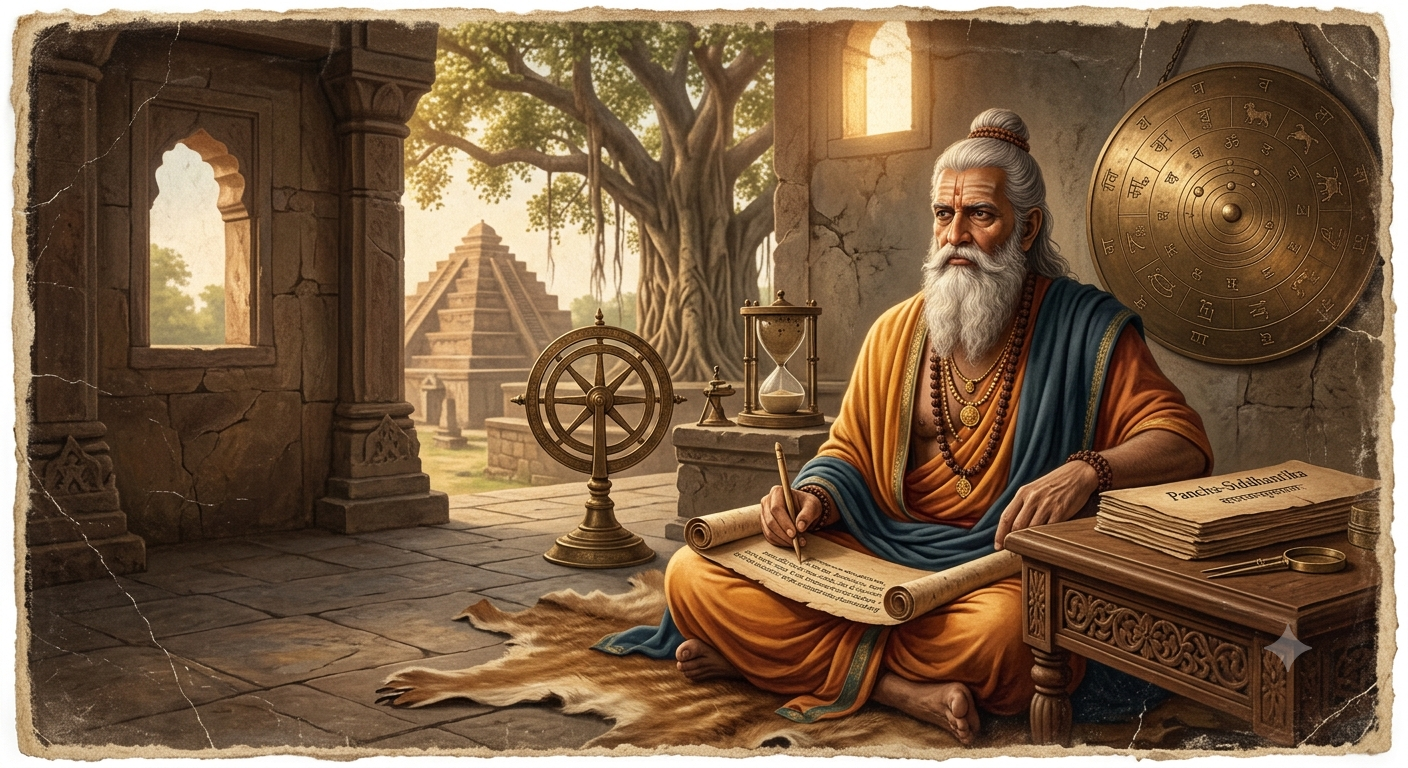
Varahamihira was one of the most important scholars of classical India. Usually placed in the 6th century CE, he worked in a period when Indian astronomy, mathematics and Jyotisha were developing through interaction among several intellectual traditions. He is strongly associated with Ujjain, one of the major centers of astronomical learning in early medieval India.
Varahamihira is best known for two major Sanskrit works: the Pancha Siddhantika, an astronomical compendium discussing five siddhantas, and the much larger Brihat Samhita, an encyclopedic work covering an extraordinary range of subjects. The Brihat Samhita includes discussions of rainfall, clouds, winds, water sources, plants, agriculture, architecture, gems, calendars, omens and celestial phenomena.
His intellectual world combined what modern readers would separate into astronomy, astrology, meteorology, environmental observation and applied knowledge. A historically accurate study of Varahamihira therefore requires both appreciation of the sophistication of his observations and recognition that ancient Jyotisha is not identical to modern experimental science.
Who Was Varahamihira?
Varahamihira's life is known primarily through literary and historical traditions rather than a modern biographical record. He is traditionally associated with the region of Avanti and the astronomical culture of Ujjain.
Later traditions connect him with the legendary court of Vikramaditya, but the historical identification of that ruler and the details of the court are debated. It is therefore safer to focus on Varahamihira's surviving works when describing his contribution.
His writings show familiarity with Indian astronomical traditions as well as material that had entered India through wider Eurasian intellectual exchange. His achievement was not simply producing one isolated discovery; it was also the collection, comparison and organization of knowledge.
Quick Facts
Pancha Siddhantika: Five Astronomical Traditions
The Pancha Siddhantika is one of Varahamihira's most important contributions to the history of astronomy. Rather than presenting a single system in isolation, the work summarizes five astronomical siddhantas known in his intellectual environment.
The five are commonly identified as the Surya Siddhanta, Paulisa Siddhanta, Romaka Siddhanta, Vasishtha Siddhanta and Paitamaha Siddhanta. The exact historical relationship between the surviving texts and the systems summarized by Varahamihira is complex, and not every original version survives in the form available today.
This makes the Pancha Siddhantika valuable as a historical record. It shows that Indian astronomers were aware of multiple computational traditions and were willing to compare and preserve them.
Astronomy and Mathematical Calculation
Classical Indian astronomy was strongly computational. Astronomers needed mathematical methods for calculating planetary positions, calendars, eclipses, rising and setting times and other celestial events.
Varahamihira inherited and summarized this computational tradition. His work belongs to a larger development in Indian astronomy that includes earlier and contemporary scholars such as Aryabhata and later astronomers who refined planetary and trigonometric calculations.
It is important not to attribute every mathematical technique found in the Indian astronomical tradition directly to Varahamihira. His special contribution was often compilation, synthesis and transmission rather than sole invention.
The Brihat Samhita
The Brihat Samhita is remarkable for its breadth. It is not simply an astronomy textbook. It is closer to an encyclopedic compendium of knowledge relevant to the society of its period.
Its subjects include celestial signs, calendars, weather, rainfall, clouds, winds, water sources, agriculture, architecture, urban features, gardens, gems, perfumes, animals, omens and rituals. The work gives modern researchers a valuable picture of how astronomy, environment, agriculture and social knowledge could be connected in a premodern intellectual system.
Varahamihira and Hydrology
One of the most frequently highlighted aspects of the Brihat Samhita is its discussion of underground water. The text contains traditional methods for identifying possible water sources using environmental signs, vegetation, terrain and other observations.
Some passages describe relationships between plants, soil, landscape features and the likelihood of finding water. These observations are especially interesting from the history of hydrology because they represent an attempt to infer hidden underground resources from visible environmental indicators.
Calling this a modern groundwater-science system would be anachronistic. Modern hydrology relies on geological surveys, hydrogeology, geophysics, drilling data, aquifer models and laboratory measurements. Varahamihira's material belongs to a much older observational tradition. Its historical importance lies in the systematic attention given to water location and environmental clues.
Rainfall, Clouds and Weather Observation
The Brihat Samhita contains extensive material concerning rainfall and atmospheric phenomena. It discusses clouds, winds, seasonal conditions and signs associated with rain.
Ancient agricultural societies depended heavily on monsoon timing. It was therefore natural that scholars would collect observations about seasonal weather. Varahamihira's text preserves this practical concern in literary and technical form.
Some traditions surrounding the Brihat Samhita are sometimes presented online as if Varahamihira had created a modern meteorological forecasting model. That claim goes too far. His work records traditional observational indicators and predictive rules, but it should not be equated with modern physics-based forecasting.
The Monsoon and Agricultural Knowledge
Rainfall was not merely an abstract subject. In an agrarian society, precipitation affected crops, water availability, food security and settlement patterns. A scholarly text that discussed clouds, seasons and rainfall therefore addressed major practical questions.
Varahamihira's environmental chapters show how celestial observations, seasonal cycles and terrestrial conditions could be interpreted together. This is one reason the Brihat Samhita remains valuable to historians of environmental knowledge.
Astronomy, Astrology and Jyotisha
Modern science and astrology are generally treated as separate domains. In classical Indian intellectual history, however, Jyotisha included astronomical calculation alongside astrological interpretation and calendrical functions.
Varahamihira worked within that intellectual framework. His writings contain astronomical calculations as well as astrology and omen traditions. A modern reader should therefore avoid both extremes: dismissing the entire corpus as “only superstition” or describing every astrological rule as experimentally validated science.
Did Varahamihira Discover Gravity?
A popular modern claim sometimes associates Varahamihira with an early discovery of gravity. This needs a clear distinction.
Varahamihira and other Indian astronomers studied celestial motion and developed mathematical astronomy. But Newtonian universal gravitation is a specific later theory formulated mathematically in the 17th century. There is no sound historical basis for claiming that Varahamihira discovered Newton's law of universal gravitation.
Recognizing this distinction does not reduce Varahamihira's importance. His actual achievements are already substantial: astronomical synthesis, calendrical knowledge and extensive environmental and technical documentation.
Interaction with Other Astronomical Traditions
The names Romaka and Paulisa in the Pancha Siddhantika are especially significant because they are often discussed in connection with astronomical knowledge outside the Indian tradition.
This evidence is part of a larger story of ancient and late-antique scientific exchange across Asia. Indian astronomy did not develop in an intellectual vacuum. At the same time, the exact pathways by which particular techniques traveled are often difficult to reconstruct.
Varahamihira's willingness to preserve multiple siddhantas demonstrates an important scholarly attitude: astronomical knowledge could be collected, compared and integrated rather than treated as the product of a single unchanging source.
Varahamihira and Ujjain
Ujjain became one of the most important centers in the history of Indian astronomy. Its geographical and cultural position supported astronomical observation and calendrical computation.
Varahamihira's association with Ujjain places him within a major lineage of Indian astronomical scholarship. Later figures, including Brahmagupta, also had strong connections with the astronomical traditions of western India.
Architecture and Applied Knowledge
The Brihat Samhita extends beyond astronomy and weather. It contains material on architecture, town planning, gardens, temples, houses and other built-environment topics.
This breadth is one of the work's greatest historical strengths. It reveals a worldview in which knowledge of nature, celestial cycles, construction, agriculture and social life could coexist in one scholarly compendium.
Gems, Minerals and Natural Materials
Varahamihira also discusses gems and other natural materials. The text contains traditional classifications and descriptions that reflect the interests of mineral identification, trade and cultural value.
These chapters should be read as historical evidence of premodern natural knowledge rather than as a direct equivalent of modern mineralogy or materials science.
Scientific Observation vs Modern Science
Varahamihira is sometimes placed into modern categories such as “scientist,” “meteorologist” or “hydrologist.” Such labels can be useful for accessibility, but they should be used carefully.
The institutional and methodological framework of modern science—controlled experiments, modern instruments, statistical analysis, peer review and mathematical physical theories—developed much later. Varahamihira belonged to a different knowledge system.
What can legitimately be highlighted is the presence of observation, classification, calculation, environmental reasoning and technical procedures. These are important components of the long history of scientific thought.
Varahamihira's Place in the Indian Scientific Tradition
Varahamihira stands between earlier and later generations of Indian astronomers. His works preserve earlier systems while also participating in a living computational tradition.
He is especially valuable because he did not restrict his scholarship to one narrow discipline. The Pancha Siddhantika focuses on astronomical systems, while the Brihat Samhita opens into a vast range of environmental, architectural and cultural subjects.
Myths vs Historical Evidence
| Popular claim | Historical assessment |
|---|---|
| Varahamihira discovered Newtonian gravity. | Unsupported. Newtonian universal gravitation is a later mathematical theory. |
| Brihat Samhita is only an astrology book. | Too narrow. It is an encyclopedic work covering many technical and environmental subjects. |
| Varahamihira invented all Indian astronomy. | Incorrect. He synthesized and transmitted multiple earlier astronomical traditions. |
| Ancient rainfall rules were modern meteorology. | They represent traditional observation and prediction, not modern numerical weather science. |
| Varahamihira's references to non-Indian traditions prove direct copying. | They demonstrate awareness of multiple traditions, but exact transmission routes are often uncertain. |
Why Varahamihira Matters Today
Varahamihira matters because his works show how broad scientific and technical knowledge could be organized in classical India. His writing connects sky and earth: astronomical calculation, seasonal cycles, rainfall, water, agriculture, architecture and natural materials all appear within one intellectual landscape.
For modern readers, the most useful approach is neither uncritical glorification nor dismissal. The historical value of Varahamihira is strongest when his actual texts are examined carefully, separating genuine observations and mathematical traditions from claims that belong to modern reinterpretation.
Conclusion
Acharya Varahamihira was a major 6th-century Indian scholar whose legacy rests especially on the Pancha Siddhantika and Brihat Samhita. His works preserve astronomical systems, computational knowledge and an extraordinary collection of material on weather, rainfall, water resources, agriculture, architecture and natural phenomena.
His importance in the history of science lies not in attaching modern discoveries to his name, but in recognizing the sophistication and breadth of the knowledge preserved in his works. Varahamihira represents an important chapter in the global history of astronomy and environmental knowledge.
परिचय
आचार्य वराहमिहिर classical India के महान scholars में से एक थे। उन्हें सामान्यतः 6वीं शताब्दी CE से जोड़ा जाता है और उनका संबंध Ujjain की astronomical tradition से माना जाता है।
उनकी दो प्रमुख रचनाएँ हैं—पंचसिद्धांतिका और बृहत्संहिता। पंचसिद्धांतिका में पाँच astronomical siddhantas की चर्चा है, जबकि बृहत्संहिता एक विशाल encyclopedic ग्रंथ है जिसमें astronomy, मौसम, वर्षा, जल-स्रोत, agriculture, architecture, gems और अनेक अन्य विषय आते हैं।
वराहमिहिर कौन थे?
वराहमिहिर के जीवन के बारे में modern biography जैसी complete जानकारी उपलब्ध नहीं है। उनका historical importance मुख्य रूप से उनकी surviving works से समझा जाता है। Ujjain और Avanti की scholarly tradition से उनका strong association माना जाता है।
उनसे जुड़े Vikramaditya के court वाले narratives popular हैं, लेकिन historical identification को लेकर debate है। इसलिए उनके actual texts को primary focus बनाना ज्यादा उचित है।
त्वरित तथ्य
पंचसिद्धांतिका
पंचसिद्धांतिका वराहमिहिर की सबसे important astronomical works में से एक है। इसमें पाँच astronomical siddhantas का summary मिलता है। इन्हें commonly Surya, Paulisa, Romaka, Vasishtha और Paitamaha Siddhanta के रूप में identify किया जाता है।
यह work इसलिए भी महत्वपूर्ण है क्योंकि इससे पता चलता है कि Indian astronomers अलग-अलग computational traditions से परिचित थे और उन्हें preserve तथा compare करते थे।
Astronomy और गणितीय गणना
Classical Indian astronomy highly computational थी। Planetary positions, calendars, eclipses और celestial events के calculations के लिए mathematics की जरूरत थी।
वराहमिहिर ने इस broader tradition को summarize और transmit किया। इसलिए हर technique को उनका personal invention कहना सही नहीं होगा। उनका बड़ा योगदान synthesis और preservation में था।
बृहत्संहिता
बृहत्संहिता केवल astrology की book नहीं है। यह एक विशाल encyclopedic work है जिसमें weather, rainfall, clouds, winds, underground water, agriculture, architecture, gardens, gems, perfumes, animals और कई cultural subjects की चर्चा मिलती है।
यह हमें दिखाता है कि premodern Indian knowledge system में sky, environment, agriculture और society को अलग-अलग isolated subjects की तरह नहीं देखा जाता था।
वराहमिहिर और Hydrology
बृहत्संहिता में underground water की खोज से जुड़े observations विशेष रूप से interesting हैं। Vegetation, soil, terrain और environmental signs के आधार पर संभावित water sources पहचानने की traditional methods का वर्णन मिलता है।
इसे modern hydrogeology कहना anachronistic होगा। Modern hydrology geological surveys, geophysics, aquifer models और measurements पर आधारित है। लेकिन historical perspective से यह important है कि ancient text ने hidden water resources को visible environmental indicators से जोड़ने का systematic attempt किया।
वर्षा, बादल और मौसम
बृहत्संहिता में rainfall और atmospheric conditions पर extensive material है। Clouds, winds, seasons और rainfall से जुड़े traditional observations दिए गए हैं।
Agrarian society में monsoon और rainfall food production और water availability के लिए बेहद महत्वपूर्ण थे। इसलिए weather observation का practical value बहुत बड़ा था।
लेकिन इसे modern numerical weather forecasting कहना सही नहीं है। ये traditional observations और predictive rules थे, modern physics-based meteorology नहीं।
Monsoon और Agriculture
Rainfall का संबंध crops, food security और water resources से था। इसलिए Varahamihira का environmental material agricultural society की practical needs से directly connected था।
Astronomy, Astrology और Jyotisha
Classical Indian context में Jyotisha के अंदर astronomical calculation, calendrical functions और astrology के elements साथ मौजूद थे। Varahamihira इसी intellectual framework में काम करते थे।
इसलिए उनकी writings को केवल “modern science” कहना भी गलत है और पूरे corpus को “only superstition” कह देना भी overly simplistic है। Astronomy और astrology दोनों historical context का हिस्सा हैं, लेकिन modern scientific validation अलग प्रश्न है।
क्या वराहमिहिर ने Gravity खोजी?
Internet पर कभी-कभी Varahamihira को gravity की discovery से जोड़ा जाता है। यह claim सावधानी से देखना चाहिए।
Varahamihira और other Indian astronomers ने celestial phenomena और astronomical calculations पर काम किया, लेकिन Newtonian universal gravitation एक much later mathematical theory है। इसलिए Varahamihira को Newton's law of universal gravitation का discoverer कहना historically justified नहीं है।
अन्य Astronomical Traditions से संपर्क
Pancha Siddhantika में Romaka और Paulisa जैसे names important हैं। ये ancient Eurasian astronomical knowledge के interaction की broader history से जुड़े हैं।
लेकिन exact transmission routes हर case में निश्चित नहीं हैं। Varahamihira की work यह दिखाती है कि multiple astronomical traditions को collect, compare और preserve किया जा रहा था।
Ujjain का महत्व
Ujjain Indian astronomy का एक major center बना। Varahamihira का association इस important astronomical culture में उनकी position को समझने में मदद करता है। Later Indian astronomers, including Brahmagupta, भी western Indian astronomical traditions से जुड़े थे।
Architecture और Applied Knowledge
बृहत्संहिता में architecture, houses, temples, gardens और built environment से संबंधित सामग्री भी मिलती है। इससे ग्रंथ की encyclopedic nature स्पष्ट होती है।
Gems और Natural Materials
Varahamihira ने gems और natural materials पर भी traditional classifications और descriptions दिए। इन्हें modern mineralogy का exact equivalent नहीं माना जाना चाहिए, लेकिन ये premodern natural knowledge का महत्वपूर्ण evidence हैं।
Ancient Observation और Modern Science
“Scientist”, “meteorologist” या “hydrologist” जैसे modern labels accessibility के लिए useful हो सकते हैं, लेकिन historical differences समझना जरूरी है। Modern science की experimental institutions, modern instruments, statistical methods और mathematical physical theories बाद में विकसित हुईं।
Varahamihira की वास्तविक historical strength observation, classification, calculation, environmental reasoning और technical procedures में दिखाई देती है।
Myths vs Facts
“Varahamihira ने Newtonian gravity discover की”: Unsupported claim.
“बृहत्संहिता सिर्फ astrology की book है”: गलत; इसमें बहुत broad encyclopedic knowledge है।
“उन्होंने पूरी Indian astronomy invent की”: गलत; उन्होंने multiple traditions को synthesize और preserve किया।
“Ancient rainfall rules modern meteorology थीं”: नहीं; वे traditional observation-based rules थे।
आज वराहमिहिर क्यों महत्वपूर्ण हैं?
वराहमिहिर की importance इस बात में है कि उनकी works classical India के broad scientific और technical knowledge का snapshot देती हैं। उनके texts में sky और earth दोनों जुड़े दिखाई देते हैं—astronomy, seasons, rainfall, water, agriculture, architecture और natural materials।
निष्कर्ष
आचार्य वराहमिहिर 6वीं शताब्दी के प्रमुख Indian scholars में से थे। पंचसिद्धांतिका और बृहत्संहिता उनकी सबसे महत्वपूर्ण works हैं। उन्होंने astronomical traditions को preserve और synthesize किया तथा environmental और technical subjects पर व्यापक material दिया।
उनकी legacy को सबसे मजबूत तरीके से समझने का तरीका यह है कि actual texts और historical context को देखें—न कि modern discoveries को बिना evidence उनके नाम से जोड़ें।
Introduction
Acharya Varahamihira classical India ke major scholars mein se ek the, generally 6th century CE se associated. Unka strong connection Ujjain ki astronomical tradition se mana jata hai.
Unki do major works hain: Pancha Siddhantika aur Brihat Samhita. Pancha Siddhantika five astronomical traditions ka compendium hai, jabki Brihat Samhita ek huge encyclopedic work hai jisme astronomy ke saath rainfall, weather, underground water, agriculture, architecture, gems aur kai other topics cover hote hain.
Varahamihira kaun the?
Varahamihira ki personal biography ke baare mein modern-style complete records available nahi hain. Unki importance primarily unke surviving texts se samjhi jati hai. Ujjain aur Avanti ki scholarly tradition se unka strong association hai.
Vikramaditya ke court se related stories popular hain, lekin historical identification debated hai. Isliye actual texts ko primary evidence maana better hai.
Pancha Siddhantika
Pancha Siddhantika Varahamihira ka important astronomical compendium hai. Isme commonly Surya, Paulisa, Romaka, Vasishtha aur Paitamaha siddhantas ki discussion milti hai.
Iska importance ye hai ki Varahamihira ne multiple astronomical traditions ko preserve aur compare kiya. Ye ek synthesis-oriented scholarly approach ko show karta hai.
Brihat Samhita
Brihat Samhita ko sirf astrology book samajhna bahut narrow hoga. Ye ek encyclopedic Sanskrit work hai jisme weather, rainfall, clouds, winds, underground water, agriculture, architecture, gardens, gems, perfumes, animals aur many cultural subjects discuss hote hain.
Varahamihira aur Hydrology
Brihat Samhita ka ek interesting part underground water se related hai. Vegetation, soil, terrain aur environmental signs ko dekhkar possible water sources identify karne ki traditional observations milti hain.
Isse modern hydrogeology kehna correct nahi hoga. Modern hydrology geological surveys, geophysics aur aquifer science par based hai. Lekin historical perspective se hidden groundwater ko visible environmental signs se connect karna noteworthy hai.
Rainfall aur Weather
Brihat Samhita mein clouds, winds, seasons aur rainfall ke extensive observations hain. Monsoon-based agricultural society mein rainfall prediction ka practical importance bahut high tha.
Lekin Varahamihira ki traditional rainfall rules ko modern numerical weather forecasting ke equal nahi rakhna chahiye. Ye historical observation-based predictive knowledge tha.
Astronomy, Astrology aur Jyotisha
Classical Indian context mein Jyotisha astronomical calculation, calendars aur astrology ke elements ko include karta tha. Varahamihira isi framework mein kaam karte the.
Isliye unki writings ko na to completely modern science bolna accurate hai, na hi entire corpus ko “only superstition” kehna. Historical categories different thi.
Did Varahamihira Discover Gravity?
Kabhi-kabhi internet par Varahamihira ko gravity discovery se connect kiya jata hai. Lekin Newtonian universal gravitation ek much later mathematical theory hai. Varahamihira ko Newton's law ka discoverer kehne ka solid historical basis nahi hai.
Is correction se Varahamihira ki actual importance kam nahi hoti. Unka real contribution astronomical synthesis, calendrical knowledge aur environmental/technical documentation mein bahut significant hai.
Other Astronomical Traditions
Pancha Siddhantika mein Romaka aur Paulisa jaise names ancient astronomical traditions ke interaction ko highlight karte hain. Indian astronomy isolated system nahi thi; knowledge exchange broader Eurasian history ka part tha.
However, exact transmission routes har case mein prove nahi kiye ja sakte. Varahamihira ka text multiple traditions ko preserve karne ke liye especially valuable hai.
Ujjain
Ujjain Indian astronomy ka important center tha. Varahamihira ka association isi intellectual environment ke context mein samjha jata hai. Later scholars jaise Brahmagupta bhi western Indian astronomical tradition se connected the.
Architecture aur Natural Knowledge
Brihat Samhita architecture, houses, temples, gardens, gems aur natural materials ko bhi discuss karti hai. Isliye ye ek broad knowledge compendium hai, not just astronomy text.
Modern Science se Difference
Modern scientist, meteorologist aur hydrologist jaise labels easy understanding ke liye useful hain, but historical differences important hain. Modern experimental science, instruments, statistical analysis aur mathematical physical theories much later institutionalize hue.
Varahamihira ki genuine historical strength observation, classification, calculation, environmental reasoning aur technical knowledge mein hai.
Myths vs Facts
Varahamihira discovered Newtonian gravity: Evidence support nahi karta.
Brihat Samhita only astrology hai: Incorrect; ye encyclopedic work hai.
He invented all Indian astronomy: Incorrect; he synthesized multiple traditions.
Ancient rainfall rules were modern meteorology: No; they were traditional observational rules.
Conclusion
Acharya Varahamihira ancient Indian astronomy aur encyclopedic knowledge ke major scholars mein se ek the. Pancha Siddhantika aur Brihat Samhita unki legacy ke core texts hain.
Unki importance ko strongest way mein samajhne ke liye actual historical texts ko study karna chahiye aur unsupported modern claims—jaise Newtonian gravity discovery—ko unke naam se attach nahi karna chahiye.
Frequently Asked Questions
Who was Varahamihira?
Varahamihira was a major 6th-century Indian scholar associated with astronomy, Jyotisha, environmental observation and encyclopedic knowledge.
What is Varahamihira famous for?
He is especially famous for the Brihat Samhita and Pancha Siddhantika.
What is the Brihat Samhita?
It is a large Sanskrit encyclopedic work covering astronomy, weather, rainfall, water, agriculture, architecture, gems and many other topics.
What is Pancha Siddhantika?
It is Varahamihira's astronomical compendium summarizing five siddhantas or astronomical traditions.
Did Varahamihira contribute to hydrology?
The Brihat Samhita contains traditional observations about groundwater, vegetation, soil and environmental indicators associated with finding water.
Did Varahamihira predict modern weather?
He recorded extensive traditional rainfall and weather observations, but these should not be equated with modern numerical weather prediction.
Did Varahamihira believe in astrology?
Yes. Astrology and Jyotisha were part of the intellectual framework of his works, alongside astronomical calculation.
Was Varahamihira influenced by Greek astronomy?
His Pancha Siddhantika preserves multiple traditions, including material associated with Romaka and Paulisa siddhantas. Specific transmission claims require historical caution.
Did Varahamihira discover gravity?
No established evidence supports the claim that he discovered Newtonian universal gravitation.
Why is Varahamihira important today?
His works preserve a broad record of classical Indian astronomical, environmental and technical knowledge.
Research Note
This article distinguishes historical evidence from modern reinterpretations. Terms such as scientist, meteorologist and hydrologist are used for accessibility, while the underlying knowledge is presented within its classical Indian Jyotisha and scholarly context.