Introduction
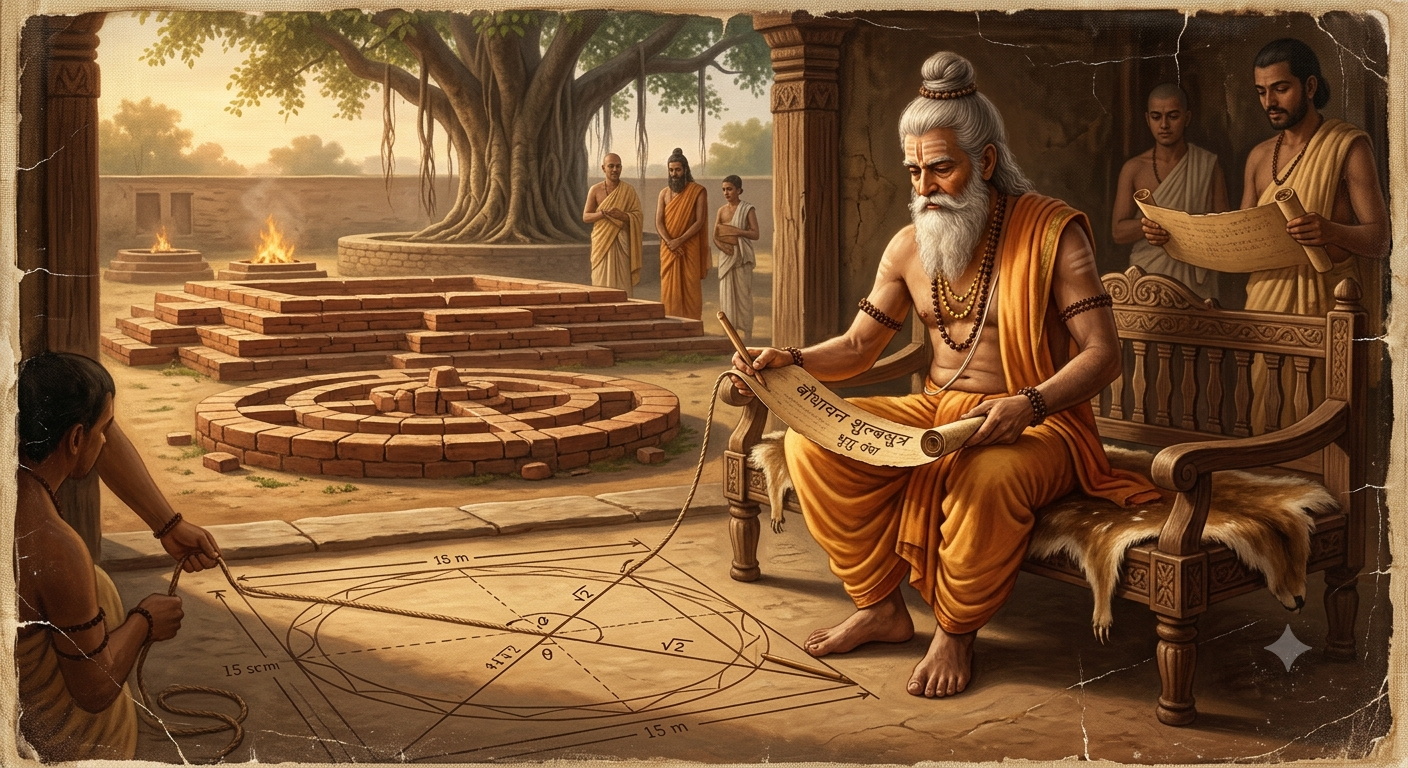
Rishi Baudhayana is traditionally associated with the Baudhayana Sulba Sutra, one of the ancient Indian texts known as the Sulba or Shulba Sutras. These works preserve geometric procedures developed for the construction of Vedic ritual altars. Although their immediate purpose was ritual architecture, the calculations required for these constructions produced a substantial body of geometric knowledge.
The Baudhayana Sulba Sutra is particularly famous because it contains a rule for the diagonal of a rectangle or right triangle that is equivalent to what is now expressed as the Pythagorean theorem: a² + b² = c². The text also contains procedures involving squares, rectangles, diagonals, areas and geometric transformations.
This history is best presented carefully. The mathematical rule found in the Baudhayana tradition is important evidence for sophisticated geometry in ancient India, but it should not be turned into an unsupported claim that one civilization simply “invented mathematics” and another copied it. Similar mathematical relationships can be discovered independently, and the surviving evidence does not prove that Pythagoras personally obtained his knowledge from Baudhayana.
Who Was Baudhayana?
Baudhayana is primarily known through the textual tradition attributed to him rather than through a securely documented biography. The Baudhayana school produced several Sanskrit works, and the Baudhayana Sulba Sutra is the text most directly relevant to the history of mathematics.
Because the Sulba Sutras belong to a very early period of Indian intellectual history, precise dates and biographies are difficult to establish. The texts were transmitted in oral and manuscript traditions, and their composition, editing and preservation likely involved historical processes rather than a single moment of writing.
For this reason, it is more historically responsible to speak of the Baudhayana textual tradition and the geometry preserved in the Sulba Sutra than to invent details about Baudhayana's personal life.
Quick Facts
What Are the Sulba Sutras?
The word Sulba or Shulba is associated with the cord or rope used for measurement. The Sulba Sutras are therefore closely connected with practical geometric construction using a measuring cord.
Several Sulba Sutra traditions are known, including those associated with Baudhayana, Apastamba, Katyayana and Manava. Their primary setting is the construction and transformation of ritual altars, where precise dimensions and areas mattered.
The geometry is practical rather than presented in the axiomatic style of later Greek geometry. Instead of beginning with definitions, postulates and formal proofs, the texts often provide rules and procedures that a practitioner can apply during construction.
The Famous Right-Triangle Rule
The most celebrated mathematical feature of the Baudhayana Sulba Sutra is its statement concerning the diagonal of a rectangle. In modern mathematical notation, the relationship is:
where a and b are the perpendicular sides and c is the diagonal.
If a rectangle has side lengths a and b, its diagonal forms the hypotenuse of a right triangle. The square of that diagonal equals the sum of the squares of the two sides.
This relation is familiar today as the Pythagorean theorem. The important historical point is that a corresponding geometric rule appears in an Indian Sulba Sutra tradition that is conventionally dated earlier than the classical Greek mathematician Pythagoras.
An Example: The 3-4-5 Triangle
A simple example illustrates the relation. Consider a right triangle with perpendicular sides of lengths 3 and 4. Their squares are 9 and 16. Their sum is 25, whose square root is 5.
The 3-4-5 example is not itself the entire historical significance of Baudhayana. It demonstrates how a right-triangle relation can be applied to practical construction and measurement.
Was This the Pythagorean Theorem?
In mathematical form, yes: the relationship described is equivalent to the Pythagorean relation. But the phrase “Pythagorean theorem” is a modern naming convention. It should not imply that Pythagoras was the first human being to know the relationship.
Different ancient cultures possessed sophisticated knowledge of right triangles and numerical relationships. The historical question is therefore more interesting than a simple “who invented it?” contest. It concerns how mathematical knowledge was discovered, transmitted, preserved and transformed in different intellectual environments.
Baudhayana and Pythagoras: What Can We Actually Say?
The Baudhayana Sulba Sutra is traditionally placed centuries before the lifetime of Pythagoras, although exact chronology of ancient Indian texts is complex. This makes the Indian evidence historically important.
However, there is no established evidence demonstrating that Pythagoras personally studied the Baudhayana Sulba Sutra or directly copied its rule. Long-distance cultural contacts existed in the ancient world, but a specific transmission route cannot be asserted without evidence.
The safest conclusion is that the right-triangle relation was known in ancient India and was preserved in the Sulba Sutra tradition. Whether similar knowledge elsewhere arose independently or through earlier, undocumented transmission remains a broader historical question.
Geometry for Ritual Architecture
Why would ritual specialists need advanced geometry? Vedic altar construction could require specific shapes, dimensions and areas. If an altar had to be constructed in a particular geometric form, a change in shape could not be allowed to change the prescribed area.
This created practical mathematical problems: how can a square be transformed into another shape of equal area? How can a rectangle be constructed with specified dimensions? How can diagonals be measured accurately with a cord? How can complex altar layouts be produced from simple geometric components?
The Sulba Sutras preserve procedures developed in response to these needs. In this sense, ancient Indian geometry emerged partly from a practical engineering-like requirement: turning numerical specifications into physical constructions.
The Cord as a Geometric Tool
A measuring cord can serve as a surprisingly powerful geometric instrument. With a cord, a builder can establish straight lines, mark equal lengths, construct right angles and compare distances.
The use of cords also makes the geometry tangible. Rather than treating mathematics as abstract symbols on paper, the Sulba tradition connects measurement directly with construction. The resulting knowledge includes relationships that are easily recognized in modern geometry.
Squares, Rectangles and Area Transformations
The Sulba Sutras are not limited to one theorem. They contain rules dealing with squares and rectangles and with transformations between geometric shapes.
Area equivalence is particularly important in altar construction. If one shape must be replaced by another while preserving its area, a geometric construction is needed rather than merely a numerical calculation.
This reveals an important characteristic of the tradition: mathematics is being used operationally. The practitioner needs a procedure that can be carried out with a cord, stakes and measurements.
Approximation and the Geometry of the Circle
Ancient geometric construction also created problems involving circles and squares. The Sulba Sutra tradition contains numerical approximations and construction rules connected with areas and geometric transformations.
These should not automatically be interpreted using modern terminology such as “exact value” or “algebraic proof.” Ancient mathematical texts often communicate results through procedures and approximations rather than symbolic derivations.
No Modern Algebraic Notation
One of the most interesting features of ancient mathematical texts is that sophisticated relationships can exist without modern symbols. The Baudhayana tradition did not write a² + b² = c² in the notation familiar to a modern student.
Instead, the relationship was expressed verbally and geometrically. Translating it into algebraic notation helps modern readers understand the mathematical content, but the notation itself belongs to a much later mathematical language.
Proof or Rule?
It is tempting to call every ancient mathematical statement a “proof,” but historical terminology matters. A modern mathematical proof generally presents a logically explicit chain of reasoning from accepted axioms or previously established propositions.
The Sulba Sutras often provide construction rules and statements of geometric relationships. They demonstrate practical mathematical knowledge, but they do not necessarily present formal proofs in the later Euclidean style.
Therefore, saying that Baudhayana “stated the Pythagorean relation” is historically safer than claiming that he produced the exact modern proof of the Pythagorean theorem.
The Broader Sulba Tradition
Baudhayana was not the only author associated with the Sulba tradition. Other texts, including the Sulba Sutras associated with Apastamba, Manava and Katyayana, also preserve geometric knowledge.
This broader textual family matters because it suggests that ancient Indian geometry was not the isolated achievement of a single individual. It was part of a continuing technical and scholarly tradition.
Baudhayana in the History of Mathematics
The importance of Baudhayana lies in what the Sulba Sutra evidence tells us about the history of mathematical thought. It shows that ancient Indian scholars developed systematic techniques for measurement, construction, area preservation and right-triangle geometry.
The text also challenges a simplistic history of mathematics in which all important geometry is presented as beginning in classical Greece. Greek geometry is enormously important, but mathematical knowledge has multiple ancient centers and traditions.
Myths vs Historical Evidence
| Popular claim | Historical assessment |
|---|---|
| Baudhayana invented all geometry. | Unsupported. The Sulba Sutras preserve one important ancient Indian geometric tradition. |
| Pythagoras stole the theorem from India. | No established evidence proves direct copying by Pythagoras. |
| The Sulba Sutras are only religious texts. | Their ritual purpose is central, but they preserve substantial practical geometry. |
| Baudhayana wrote modern algebraic formulas. | The modern notation is a later representation of the mathematical relationship. |
| The Baudhayana rule is exactly the same as a modern formal proof. | The relationship is equivalent, but the textual presentation is primarily a rule/procedure rather than a modern axiomatic proof. |
Why Baudhayana Matters Today
Baudhayana matters because his associated text provides a window into a sophisticated ancient mathematical culture. It demonstrates that geometry was not merely theoretical: it was embedded in measurement, construction and the organization of physical space.
For students, the story also provides a useful lesson in mathematical history. A theorem can have a modern name without the underlying relationship being unique to the person whose name became attached to it. Historical mathematics is often a story of parallel discovery, transmission and gradual formalization.
Conclusion
Rishi Baudhayana is remembered primarily through the Baudhayana Sulba Sutra, a key source for ancient Indian geometric knowledge. Its right-triangle diagonal rule is equivalent to the mathematical relation now called the Pythagorean theorem, and its practical geometry reflects the needs of Vedic altar construction.
The strongest historical conclusion is not that Baudhayana single-handedly invented geometry or that Pythagoras copied him. Rather, the Sulba Sutra tradition is powerful evidence that sophisticated geometric reasoning existed in ancient India and that the history of mathematics is broader and more interconnected than a single-civilization narrative suggests.
परिचय
ऋषि बौधायन को परंपरागत रूप से बौधायन शुल्ब सूत्र से जोड़ा जाता है। शुल्ब सूत्र प्राचीन भारतीय संस्कृत ग्रंथों की एक परंपरा है, जिसमें Vedic ritual altars के निर्माण के लिए geometric measurements और constructions दिए गए हैं।
बौधायन शुल्ब सूत्र विशेष रूप से प्रसिद्ध है क्योंकि इसमें rectangle या right triangle के diagonal से जुड़ा एक नियम मिलता है जो आधुनिक रूप में a² + b² = c² के बराबर है। यही relation आज Pythagorean theorem के नाम से जाना जाता है।
लेकिन history को carefully समझना जरूरी है। यह कहना कि Pythagoras ने निश्चित रूप से Baudhayana से theorem copy की थी, evidence से साबित नहीं है। ज्यादा सुरक्षित conclusion यह है कि ancient India में right-triangle geometry का sophisticated knowledge मौजूद था।
बौधायन कौन थे?
Baudhayana के बारे में detailed personal biography securely established नहीं है। उनका मुख्य महत्व उनके नाम से जुड़ी textual tradition, खासकर Baudhayana Sulba Sutra, में है।
Ancient Indian texts oral और manuscript traditions से transmit हुए, इसलिए exact dates और individual biographies को modern historical certainty के साथ establish करना difficult है। इसलिए Baudhayana की personal life के बारे में unsupported details देना उचित नहीं है।
शुल्ब सूत्र क्या हैं?
“Sulba” या “Shulba” का संबंध measuring cord या rope से माना जाता है। इन texts में cord की मदद से geometric construction, measurement और altar design की procedures दी गई हैं।
Baudhayana के अलावा Apastamba, Katyayana और Manava से जुड़े Sulba traditions भी मिलते हैं। इसका मतलब है कि यह किसी एक व्यक्ति का isolated achievement नहीं बल्कि एक wider mathematical tradition था।
Pythagorean Theorem से संबंध
Modern notation में famous relation है:
यहाँ a और b right triangle की perpendicular sides हैं और c hypotenuse यानी diagonal है। Baudhayana tradition में इसी mathematical relationship का geometric rule मिलता है।
3-4-5 Triangle
अगर right triangle की sides 3 और 4 हों, तो 3² + 4² = 9 + 16 = 25 = 5²। इसलिए hypotenuse 5 होगा। यह simple example right-triangle relation को समझने का अच्छा तरीका है।
क्या Baudhayana ने Pythagorean Theorem discover किया?
Mathematical relationship के स्तर पर Baudhayana Sulba Sutra में Pythagorean relation के equivalent rule का evidence मिलता है। Textual chronology के अनुसार यह Pythagoras से earlier tradition से जुड़ा माना जाता है।
लेकिन “Pythagoras ने India से copy किया” कहना justified नहीं है। Direct transmission का established evidence नहीं है। Mathematical relationships अलग-अलग cultures में independently भी develop हो सकती हैं।
Ritual Architecture और Geometry
Vedic altar construction में specific shapes, dimensions और areas की आवश्यकता होती थी। एक shape को दूसरे shape में बदलते समय area preserve करना पड़ सकता था। इसी practical requirement ने sophisticated geometry को जन्म देने में भूमिका निभाई।
इसलिए Sulba geometry को केवल abstract mathematics के रूप में देखना incomplete होगा। यह measurement और physical construction से directly connected थी।
Cord एक Mathematical Tool के रूप में
Measuring cord की मदद से straight lines, equal lengths, right angles और distances establish किए जा सकते हैं। यही वजह है कि “Sulba” tradition practical geometry का अच्छा example है।
Squares, Rectangles और Area
Sulba Sutras में squares और rectangles से जुड़े geometric procedures मिलते हैं। Area preservation और shape transformation altar construction में important थे। इससे पता चलता है कि mathematics को practical construction procedures में use किया जा रहा था।
Modern Algebraic Formula नहीं थी
Ancient text में modern notation a² + b² = c² नहीं लिखा गया था। Modern formula केवल ancient geometric rule को today's mathematical language में represent करती है।
यह distinction important है क्योंकि mathematical idea और उसकी symbolic notation अलग historical developments हैं।
Proof या Rule?
Modern mathematical proof एक formal logical chain होती है। Sulba Sutras अक्सर construction rules और geometric procedures देती हैं। इसलिए यह कहना safer है कि Baudhayana tradition ने right-triangle relation का rule preserve किया, बजाय इसके कि उसने exactly modern Euclidean proof प्रस्तुत किया था।
Ancient Indian Mathematics में महत्व
Baudhayana tradition दिखाती है कि ancient India में measurement, geometry, area transformation और right-triangle relationships पर systematic practical knowledge मौजूद था। यह mathematics की history को केवल Greek-centered narrative से wider बनाता है।
Myths vs Facts
“Baudhayana ने पूरी geometry invent की”: यह unsupported claim है।
“Pythagoras ने theorem India से चोरी की”: Direct copying का established evidence नहीं है।
“Sulba Sutras सिर्फ religious texts हैं”: इनका ritual context important है, लेकिन इनमें substantial practical geometry भी है।
“Baudhayana ने modern algebra लिखा”: Modern notation बाद की mathematical language है।
आज Baudhayana क्यों महत्वपूर्ण हैं?
Baudhayana का महत्व इस बात में है कि उनके associated text से ancient Indian geometry की sophistication का evidence मिलता है। Geometry यहाँ physical construction, measurement और space organization से जुड़ी हुई थी।
निष्कर्ष
ऋषि बौधायन को Baudhayana Sulba Sutra tradition के माध्यम से ancient Indian geometry के महत्वपूर्ण नाम के रूप में जाना जाता है। Right-triangle diagonal rule आधुनिक Pythagorean relation के equivalent है और Vedic altar construction की practical जरूरतों से जुड़ा हुआ था।
सबसे balanced historical conclusion यह है कि ancient India में sophisticated geometry मौजूद थी। इसे न तो unsupported तरीके से “all mathematics का invention” कहना चाहिए और न ही Pythagoras की direct copying का दावा करना चाहिए।
Introduction
Rishi Baudhayana ko traditionally Baudhayana Sulba Sutra se associate kiya jata hai. Sulba Sutras ancient Indian texts ki ek tradition hain jo Vedic ritual altars ki geometric construction aur measurement se related hain.
Baudhayana Sulba Sutra ka sabse famous mathematical point right triangle ke diagonal ka rule hai, jo modern notation mein a² + b² = c² ke equivalent hai. Aaj ise Pythagorean theorem kaha jata hai.
History ko balanced rakhna important hai: Baudhayana tradition ka mathematical evidence strong historical interest rakhta hai, lekin Pythagoras ne directly Baudhayana se copy kiya tha, iska established proof nahi hai.
Baudhayana kaun the?
Baudhayana ki detailed personal biography securely known nahi hai. Unka main historical importance unse associated textual tradition mein hai, especially Baudhayana Sulba Sutra mein.
Ancient Indian texts oral aur manuscript traditions se transmit hue, isliye exact dates aur personal details ko certainty ke saath establish karna difficult hai.
Sulba Sutras kya hain?
“Sulba/Shulba” measuring cord ya rope se related term hai. In texts mein cord ki help se lines, lengths, angles, areas aur altar shapes construct karne ke rules milte hain.
Baudhayana ke saath Apastamba, Katyayana aur Manava ki Sulba traditions bhi known hain. Isliye ye ek broader mathematical tradition thi.
Pythagorean Relation
Right triangle mein a aur b perpendicular sides hain aur c hypotenuse/diagonal hai. Baudhayana tradition mein isi relation ka equivalent geometric rule milta hai.
3-4-5 Example
3² + 4² = 9 + 16 = 25 = 5². Isliye 3 aur 4 sides wale right triangle ka diagonal 5 hota hai. Ye relation practical construction aur measurement mein useful hai.
Did Baudhayana Discover Pythagorean Theorem?
Baudhayana Sulba Sutra mein Pythagorean relation ke equivalent rule ka evidence milta hai, aur tradition Pythagoras se earlier chronology se associated hai.
Lekin “Pythagoras copied Baudhayana” kehna historically prove nahi hua hai. Direct transmission ka evidence absent hai. Independent discovery ya older undocumented transmission dono possibilities ko simple historical slogan se replace nahi karna chahiye.
Ritual Architecture ne Geometry ko kaise motivate kiya?
Vedic altars ke liye exact shapes, dimensions aur areas important the. Shape transform karte waqt area preserve karna practical mathematical problem tha. Isi type ki needs ne sophisticated geometric procedures ko useful banaya.
Measuring Cord ka Importance
Ek cord se straight lines, equal distances aur right angles establish kiye ja sakte hain. Isliye Sulba geometry ek practical construction-based mathematics ka example hai.
Modern Formula vs Ancient Rule
Ancient text modern algebraic notation a² + b² = c² mein nahi likha gaya tha. Ye modern representation hai jo ancient geometric relationship ko easily explain karti hai.
Proof ya Procedure?
Modern proof formal logical steps follow karta hai. Sulba Sutras largely rules aur construction procedures provide karte hain. Isliye “Baudhayana stated a rule equivalent to the Pythagorean relation” historically safer wording hai than “Baudhayana gave the modern formal proof.”
Baudhayana ka Mathematical Importance
Baudhayana tradition ancient India mein measurement, geometry, area transformations aur right-triangle relationships ke sophisticated use ka evidence deti hai. Ye mathematics ki history ko ek single civilization se bahar dekhne mein help karti hai.
Myths vs Facts
Baudhayana invented all geometry: Unsupported.
Pythagoras stole the theorem from India: Direct evidence nahi hai.
Sulba Sutras only religious texts hain: Ritual purpose important hai, but substantial geometry bhi preserved hai.
Baudhayana wrote modern algebra: Modern notation later development hai.
Conclusion
Rishi Baudhayana ka importance Baudhayana Sulba Sutra aur usme preserved geometric knowledge mein hai. Right-triangle diagonal rule modern Pythagorean relation ke equivalent hai aur ancient Indian ritual construction ki practical needs se connected tha.
Best historical conclusion ye hai ki ancient India mein sophisticated geometry ka strong evidence milta hai, while Pythagoras ke direct copying ka claim evidence se establish nahi hota.
About this article
This article has been prepared for educational and historical research purposes using primary sources, scholarly references, and reputable historical or academic resources where available.
Historical claims are presented with appropriate context, and claims that remain debated are identified as such.
Article information
Author: Hindu Research Portal Editorial Team
Published: Not specified
Last updated: 11 August 2026
Category: Indian Mathematics · Geometry
Evidence Status
🟢 Well established
The Baudhayana Sulba Sutra preserves a geometric rule equivalent to the Pythagorean relation. The broader questions of exact chronology, independent discovery, and transmission remain historically nuanced.
Claim → Evidence → Interpretation → Caveat
Claim: The Baudhayana Sulba Sutra contains a right-triangle/diagonal rule equivalent to a² + b² = c².
Evidence: MacTutor's discussion of the Sulba Sutras and Baudhayana describes the relevant geometric rule and places the Baudhayana tradition among the earliest surviving Indian mathematical texts.
Interpretation: The evidence supports the historical claim as stated, while stronger claims about priority, direct influence, or equivalence with modern concepts should not be inferred without additional evidence.
Caveat: Where historical chronology or interpretation is debated, this article treats the uncertainty as part of the evidence rather than presenting one interpretation as settled fact.
Sources & Further Reading
- Primary / historical context: Baudhayana Sulba Sutra — historical overview
- Scholarly reference: Baudhayana — MacTutor History of Mathematics
- Further reading: Sulba Sutras — MacTutor project
Frequently Asked Questions
Who was Baudhayana?
Baudhayana is traditionally associated with the Baudhayana Sulba Sutra, an ancient Indian text of geometric construction.
Did Baudhayana discover the Pythagorean theorem?
The Baudhayana Sulba Sutra contains a rule equivalent to the Pythagorean relation. The historical evidence does not prove that Pythagoras directly copied it from Baudhayana.
What is the Baudhayana Sulba Sutra?
It is a Sanskrit geometric text associated with the construction and transformation of Vedic ritual altars.
What is the Baudhayana theorem?
The term commonly refers to the right-triangle diagonal relation found in the Baudhayana Sulba Sutra, equivalent to a² + b² = c².
What are Sulba Sutras?
They are ancient Indian geometric texts connected with Vedic altar construction and measurement using cords and other practical techniques.
Was Baudhayana's rule a formal proof?
The text provides geometric rules and procedures. It should not automatically be described as a modern axiomatic proof.
Did Pythagoras copy Baudhayana?
There is no established evidence proving that Pythagoras directly copied Baudhayana.
What does Sulba mean?
Sulba or Shulba refers to the cord or rope associated with measurement and geometric construction.
Why are the Sulba Sutras important?
They preserve evidence of systematic geometric reasoning in ancient India, including right-triangle relations, area transformations and construction procedures.
Why is Baudhayana relevant today?
The tradition is important for understanding the global and multi-centered history of mathematics and the practical origins of geometric reasoning.
Research Note
This article separates the mathematical content preserved in the Baudhayana tradition from stronger historical claims about personal discovery, transmission or direct influence. The modern equation is used as a translation of the geometric relationship, not as a claim about ancient notation.