Introduction
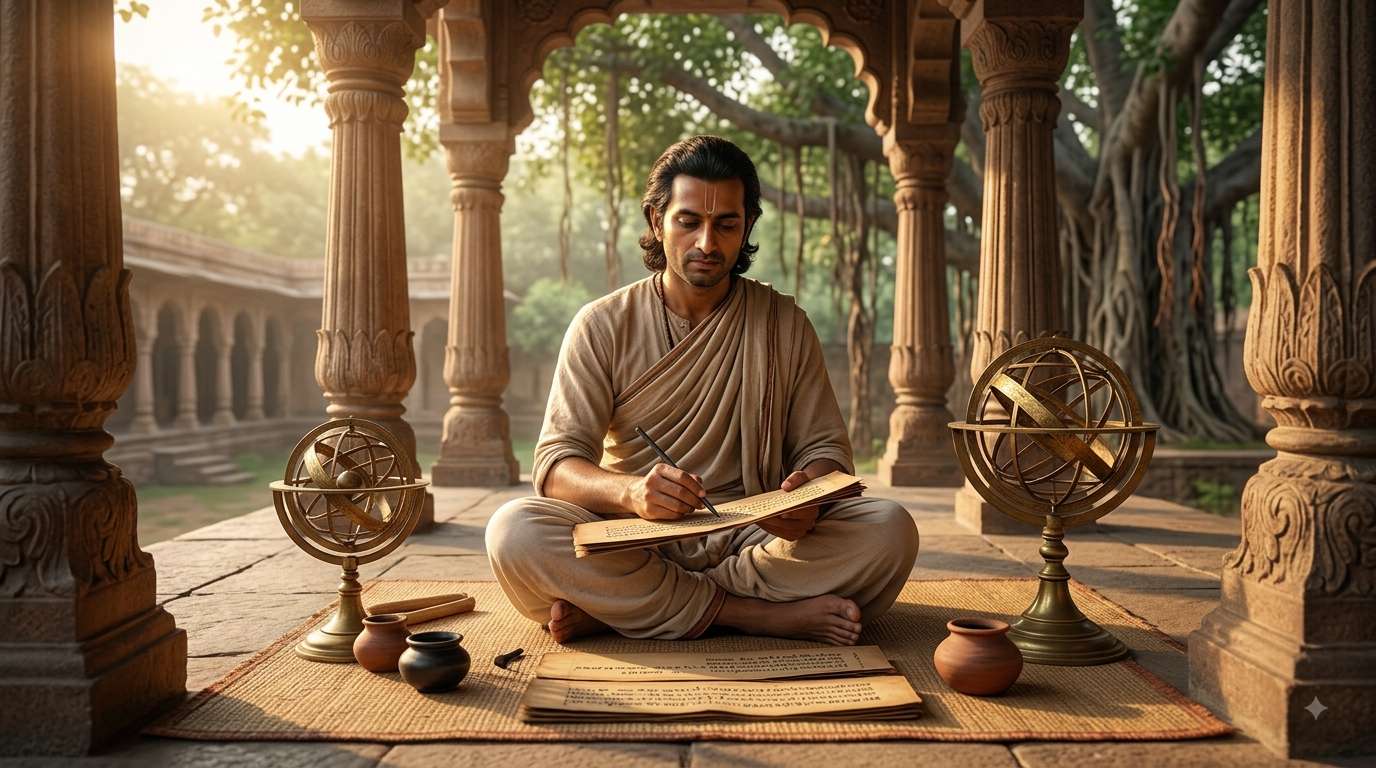
Sridhara, also known in the tradition as Sridharacharya, was an important Indian mathematician associated with arithmetic and algebra. The project data places him approximately in the 8th–9th century CE.
He is especially remembered because a celebrated method for solving quadratic equations is traditionally associated with his name. In modern textbooks the result appears as the quadratic formula, but the historical development is better understood as a long mathematical process rather than as a single modern-style invention.
Sridhara's place in Indian mathematics is important because his work belongs to a period in which arithmetic procedures and algebraic problem solving were becoming increasingly systematic and computationally sophisticated.
Who Was Sridhara?
Sridhara was an Indian mathematician whose name is connected with arithmetic and algebra. Compared with some later figures, relatively little biographical information survives, so his mathematical reputation rests primarily on the works and procedures attributed to him.
Historical descriptions should therefore distinguish between what is securely known about his mathematical tradition and later popular retellings. His association with quadratic equations is strong in the history of Indian mathematics, while the modern symbolic presentation of the formula is much later.
Quick Facts
Arithmetic and Algebra in India
Indian mathematics developed a strong tradition of procedural arithmetic. Problems involving numbers, fractions, proportions, measurements and unknown quantities were treated through rules that could be applied repeatedly.
Algebra emerged naturally from this computational environment. Once an unknown quantity was represented through a general procedure, a problem could be solved by following a sequence of operations rather than by treating every numerical example as completely separate.
Sridhara belongs to this wider development. His association with quadratic equations is one of the clearest examples of how algebraic problem solving could be expressed through a systematic rule.
Quadratic Equations
A quadratic equation is an equation in which the highest power of the unknown is two. In modern notation, its general form is:
where a ≠ 0.
Quadratic problems arise in many settings, including geometry, measurement and numerical word problems. A general method for solving them is therefore much more powerful than a rule designed for only one particular example.
The Method Associated with Sridhara
Sridhara is traditionally linked with a rule equivalent to the modern solution of the general quadratic equation. In today's notation, the familiar result is:
The symbols shown here are modern. Historical Indian mathematicians did not write the formula using the same algebraic notation used in contemporary textbooks. The important historical point is the procedure and mathematical relationship, not the modern typography.
Because mathematical techniques developed across cultures and over long periods, it is better to say that Sridhara is traditionally associated with an important quadratic-solving method than to claim that he single-handedly invented all forms of the modern formula.
Understanding the Formula
The quadratic formula converts the general equation ax² + bx + c = 0 into expressions for the possible values of x. The ± sign represents two possible branches when the square root is real.
The quantity under the square root, b² − 4ac, is called the discriminant in modern mathematics. It provides immediate information about the roots.
Two distinct real roots.
One repeated real root.
No real roots; complex roots occur in modern algebra.
A Simple Example
Consider the quadratic equation:
Here a = 1, b = −5 and c = 6. The discriminant is:
The two solutions are therefore:
This simple example shows why a general rule is useful: once the coefficients are known, the same method can be applied systematically.
Why General Rules Matter
One of the most important features of algebra is the move from individual numerical problems to general procedures. Instead of solving one equation and stopping, a rule can describe an entire class of equations.
This procedural approach is a major strength of historical Indian mathematics. Mathematical knowledge was often organized through algorithms and rules that could be repeatedly applied to new numerical situations.
Sridhara's association with quadratic equations fits naturally into this tradition of systematic computation.
Arithmetic Foundations
Algebra does not stand alone. Operations with positive and negative quantities, fractions, ratios and numerical expressions form the computational foundation on which algebraic procedures operate.
Indian mathematical traditions developed detailed methods for arithmetic calculation, making it possible to handle increasingly complicated numerical problems.
Sridhara is therefore best viewed not only through the famous quadratic formula association, but as part of a broader arithmetic-algebraic culture.
From Word Problems to Algebra
Many historical algebra problems begin as statements about quantities rather than as symbolic equations. A problem might describe an area, a product of two quantities, a difference between numbers or another numerical relationship.
The mathematical challenge is to translate the verbal conditions into a general relationship involving an unknown quantity. Once that relationship becomes quadratic, a systematic solution method becomes especially valuable.
Historical Development of the Quadratic Method
The history of quadratic equations is not the story of one person suddenly creating a complete formula. Methods for particular quadratic forms developed in different mathematical cultures and at different times.
Indian mathematicians contributed significantly to this long development. Sridhara is remembered in this context because of the method associated with his name for solving quadratic equations.
The modern formula is a compact symbolic summary of algebraic procedures whose historical development involved many mathematicians and mathematical traditions.
Sridhara and Later Indian Mathematicians
Sridhara belongs to the continuing Indian mathematical tradition that included major figures before and after him. Earlier mathematicians such as Brahmagupta developed important rules for arithmetic and algebra, while later mathematicians such as Bhaskara II expanded algebraic and astronomical mathematics further.
Seen in this sequence, Sridhara is part of a sustained intellectual tradition rather than an isolated figure.
Mathematics Without Modern Symbolism
Modern algebra relies heavily on letters such as x, a, b and c. Historical mathematical texts often used words, verse, abbreviations or rhetorical descriptions instead.
That difference in notation should not be mistaken for a difference in mathematical sophistication. A rule can be mathematically general even when it is expressed verbally rather than through modern symbols.
When we write Sridhara's method as x = (−b ± √(b²−4ac))/(2a), we are translating its mathematical structure into a later symbolic language.
Why the Quadratic Formula Is Powerful
The formula works for every quadratic equation in the general form, provided a ≠ 0. This universality is what makes it such an important algebraic tool.
It also exposes the relationship between the coefficients and the roots. The discriminant tells us whether the roots are real and whether they are distinct or repeated.
Such general relationships are among the defining strengths of algebra: one rule can replace a large collection of separate numerical tricks.
Sridhara's Historical Importance
The project data describes Sridhara as an important Indian mathematician associated with arithmetic and algebra and traditionally linked with a celebrated method for solving quadratic equations.
This makes him particularly relevant to the history of algebraic computation. His name connects an Indian mathematical tradition with one of the most familiar procedures taught in modern algebra.
Myths vs Historical Evidence
| Popular claim | Historical assessment |
|---|---|
| Sridhara personally invented the entire modern quadratic formula exactly as written today. | The modern symbols are later notation. Sridhara is traditionally associated with an equivalent quadratic-solving method. |
| Sridhara and Bhaskaracharya II were the same mathematician. | False. They belong to different periods. |
| Algebra began with one single civilization and had no parallel development. | Mathematics developed through multiple traditions and long processes of transmission and refinement. |
| A historical formula must use modern x, a, b and c to be algebra. | No. Mathematical generality can be expressed verbally or algorithmically as well as symbolically. |
| Sridhara's importance is only a modern school-book association. | His traditional association with arithmetic and algebra places him within a substantial historical Indian mathematical tradition. |
Why Sridhara Matters Today
Every time students solve a quadratic equation using the familiar formula, they are using a compact representation of a much longer historical development in algebra.
Sridhara is important because his name is connected to this development in the Indian mathematical tradition. His story encourages us to look beyond modern notation and ask how general mathematical procedures were developed, communicated and preserved.
Conclusion
Sridhara, or Sridharacharya, was an important Indian mathematician associated with arithmetic and algebra, generally placed around the 8th–9th century CE in the project data.
He is traditionally linked with a celebrated method for solving quadratic equations. Although the modern quadratic formula is written in symbolic notation developed later, the underlying algebraic procedure belongs to a long history of mathematical problem solving in which Indian mathematicians made important contributions.
परिचय
श्रीधराचार्य, जिन्हें Sridhara के नाम से भी जाना जाता है, भारतीय गणित के महत्वपूर्ण आचार्य थे। परियोजना के डेटा के अनुसार उनका काल लगभग 8वीं–9वीं शताब्दी ई. माना गया है।
वे अंकगणित और बीजगणित से जुड़े हुए हैं तथा द्विघात समीकरणों को हल करने की एक प्रसिद्ध विधि की परंपरा उनके नाम से जुड़ी है।
उनका महत्व केवल एक सूत्र तक सीमित नहीं है। वे उस भारतीय गणितीय परंपरा का हिस्सा थे जिसमें arithmetic procedures और algebraic problem solving को व्यवस्थित रूप दिया गया।
श्रीधराचार्य कौन थे?
श्रीधराचार्य भारतीय गणितज्ञ थे जिनका नाम अंकगणित और बीजगणित से जुड़ा है। उनके जीवन के बारे में आधुनिक शैली की विस्तृत जीवनी उपलब्ध नहीं है, इसलिए उनका historical importance मुख्यतः उनसे जुड़ी mathematical tradition और procedures से समझा जाता है।
उनके बारे में लोकप्रिय दावों को historical evidence से अलग रखना जरूरी है। द्विघात समीकरण की विधि से उनका संबंध महत्वपूर्ण है, लेकिन modern symbolic formula बाद की notation में लिखा गया है।
त्वरित तथ्य
भारत में अंकगणित और बीजगणित
भारतीय गणित में procedural arithmetic की एक मजबूत परंपरा थी। संख्याओं, भिन्नों, अनुपातों, माप और अज्ञात राशियों से जुड़े problems को rules के माध्यम से solve किया जाता था।
इसी computational environment से algebra का systematic development भी जुड़ा। जब unknown quantity को general procedure के माध्यम से treat किया जाने लगा, तब एक ही rule को अलग-अलग problems पर लागू किया जा सकता था।
श्रीधराचार्य इसी व्यापक development का हिस्सा हैं। द्विघात समीकरणों से उनका संबंध systematic algebraic problem solving का एक अच्छा उदाहरण है।
द्विघात समीकरण क्या है?
जिस equation में unknown की highest power 2 होती है, उसे quadratic equation या द्विघात समीकरण कहा जाता है। आधुनिक notation में इसका general form है:
जहाँ a ≠ 0.
Quadratic problems geometry, measurement और numerical word problems में भी आ सकते हैं। इसलिए general solving method का महत्व बहुत अधिक है।
श्रीधर से जुड़ी द्विघात विधि
श्रीधराचार्य के नाम से quadratic equation को solve करने की एक प्रसिद्ध विधि की परंपरा जुड़ी है। आधुनिक notation में इसका familiar result इस प्रकार लिखा जाता है:
यहाँ इस्तेमाल हुए symbols modern हैं। ऐतिहासिक भारतीय गणितज्ञों ने इसी तरह के ideas को आज के textbook notation में नहीं लिखा था। इसलिए historical significance procedure और mathematical relationship में है, modern typography में नहीं।
इसे एक single modern invention की तरह प्रस्तुत करने के बजाय, भारतीय और अन्य mathematical traditions में लंबे समय तक विकसित algebraic methods के हिस्से के रूप में देखना अधिक उचित है।
Formula को समझना
Quadratic formula general equation ax² + bx + c = 0 से possible values of x निकालने का तरीका देता है। ± sign दो possible branches को दर्शाता है जब square root real हो।
Square root के अंदर आने वाली quantity b² − 4ac को modern mathematics में discriminant कहा जाता है।
दो अलग real roots.
एक repeated real root.
Real roots नहीं; modern algebra में complex roots.
एक सरल उदाहरण
Equation लें:
यहाँ a = 1, b = −5 और c = 6 हैं। Discriminant होगा:
इसलिए दो solutions हैं:
यह example दिखाता है कि general rule का उपयोग करके पूरी class of equations को systematic तरीके से solve किया जा सकता है।
General Rules क्यों महत्वपूर्ण हैं?
Algebra की बड़ी ताकत यह है कि individual numerical problems से आगे बढ़कर general procedures बनाए जा सकते हैं। एक rule पूरी class की problems पर लागू हो सकता है।
भारतीय गणित में algorithms और rules के माध्यम से calculations को व्यवस्थित करना एक महत्वपूर्ण परंपरा रही। श्रीधर का quadratic method association इसी systematic approach में समझा जा सकता है।
अंकगणित की नींव
Algebra की नींव arithmetic operations पर होती है। Positive और negative quantities, fractions, ratios और numerical expressions को handle करने की क्षमता complex algebraic problems को solve करने में मदद करती है।
इसलिए श्रीधराचार्य को केवल quadratic equation के संदर्भ में नहीं, बल्कि व्यापक arithmetic-algebraic tradition के संदर्भ में देखना अधिक उपयोगी है।
Word Problems से Algebra तक
Historical algebra problems अक्सर verbal statements से शुरू होते थे। किसी quantity का area, product, difference या किसी अन्य relation के रूप में description दिया जा सकता था।
Mathematical challenge था उस verbal condition को unknown quantity के साथ general relationship में बदलना। जब relationship quadratic बनती है, तब systematic solution method की आवश्यकता होती है।
Quadratic Method का Historical Development
Quadratic equations का इतिहास किसी एक व्यक्ति द्वारा अचानक complete modern formula invent करने की कहानी नहीं है। अलग-अलग mathematical cultures में particular quadratic forms को solve करने की methods विकसित हुईं।
भारतीय गणितज्ञों ने इस लंबे development में महत्वपूर्ण योगदान दिया। श्रीधराचार्य इसी context में एक प्रसिद्ध quadratic-solving method से जुड़े हुए हैं।
Modern formula historical procedures को compact symbolic form में दिखाता है; उसका development एक लंबे mathematical process का परिणाम है।
श्रीधर और बाद के भारतीय गणितज्ञ
श्रीधर उस continuous Indian mathematical tradition का हिस्सा हैं जिसमें उनसे पहले ब्रह्मगुप्त जैसे mathematicians ने arithmetic और algebra में महत्वपूर्ण rules दिए और बाद में भास्कराचार्य द्वितीय ने algebraic तथा astronomical mathematics को और विकसित किया।
इस sequence में श्रीधर एक isolated figure नहीं बल्कि sustained intellectual tradition की एक महत्वपूर्ण कड़ी दिखाई देते हैं।
Modern Symbols के बिना Mathematics
आज algebra में x, a, b और c जैसे letters का उपयोग होता है। Historical texts में words, verses, abbreviations या verbal descriptions का उपयोग अधिक हो सकता था।
Notation अलग होने का अर्थ mathematical sophistication का कम होना नहीं है। कोई rule verbal या algorithmic form में भी general हो सकता है।
Quadratic Formula की शक्ति
General quadratic equation के लिए एक ही formula बहुत सारे अलग numerical problems पर लागू किया जा सकता है। यही universality इसे algebra का powerful tool बनाती है।
Discriminant coefficients और roots के relationship को भी सामने लाता है और बताता है कि roots real, repeated या complex किस प्रकार के हो सकते हैं।
श्रीधराचार्य का ऐतिहासिक महत्व
परियोजना के data के अनुसार श्रीधर arithmetic और algebra से जुड़े महत्वपूर्ण भारतीय mathematician हैं और quadratic equations को solve करने की celebrated method की परंपरा उनके नाम से जुड़ी है।
इसी वजह से उनका नाम algebraic computation के history में विशेष रूप से महत्वपूर्ण है।
Myths vs Historical Evidence
| लोकप्रिय दावा | ऐतिहासिक स्थिति |
|---|---|
| श्रीधर ने आज का पूरा quadratic formula exactly इसी notation में invent किया था। | Modern symbols बाद की notation हैं। श्रीधर एक equivalent quadratic-solving method से traditionally जुड़े हैं। |
| श्रीधर और भास्कराचार्य द्वितीय एक ही mathematician थे। | गलत। दोनों अलग historical periods के mathematicians थे। |
| Algebra का development केवल एक civilization ने किया। | Mathematics कई traditions और लंबे historical processes से विकसित हुआ। |
| Modern x, a, b, c के बिना algebra नहीं हो सकता। | General mathematical procedures verbal और algorithmic रूप में भी व्यक्त किए जा सकते हैं। |
| श्रीधर का महत्व केवल school formula तक सीमित है। | वे arithmetic और algebra की व्यापक Indian mathematical tradition का महत्वपूर्ण हिस्सा हैं। |
आज श्रीधराचार्य क्यों महत्वपूर्ण हैं?
आज जब students quadratic equation solve करने के लिए familiar formula use करते हैं, तब वे एक बहुत लंबे historical development की mathematical technique का उपयोग कर रहे होते हैं।
श्रीधराचार्य का नाम इस development की Indian tradition से जुड़ा है। उनका अध्ययन यह समझने में मदद करता है कि general mathematical procedures कैसे विकसित, communicate और preserve किए गए।
निष्कर्ष
श्रीधराचार्य लगभग 8वीं–9वीं शताब्दी ई. के महत्वपूर्ण भारतीय गणितज्ञ माने जाते हैं। परियोजना के data के अनुसार वे अंकगणित और बीजगणित से जुड़े हैं तथा द्विघात समीकरणों को हल करने की एक प्रसिद्ध विधि की परंपरा उनके नाम से जुड़ी है।
Modern quadratic formula बाद की symbolic notation में लिखा गया है, लेकिन उसके पीछे की algebraic problem-solving tradition का इतिहास बहुत लंबा है। श्रीधराचार्य इस भारतीय गणितीय विकास की एक महत्वपूर्ण कड़ी हैं।
Introduction
Sridhara, ya Sridharacharya, ek important Indian mathematician the jo arithmetic aur algebra se associated hain. Project data ke according unka period approximately 8th–9th century CE hai.
Unka naam especially quadratic equations solve karne ki ek celebrated method ke saath traditionally connected hai. Aaj isi result ko modern textbooks mein quadratic formula ke form mein likha jata hai, lekin historical development ko ek long process ke roop mein samajhna better hai.
Sridhara Indian mathematics ki us tradition ka part hain jahan arithmetic procedures aur algebraic problem solving increasingly systematic ban rahe the.
Sridhara kaun the?
Sridhara ek Indian mathematician the jinka naam arithmetic aur algebra se connected hai. Unki detailed biography limited hai, isliye unka importance mainly unse associated mathematical tradition aur procedures se samjha jata hai.
Unke baare mein popular claims ko historical evidence se alag rakhna important hai. Quadratic equations ke solving method ke saath unka association significant hai, jabki modern symbolic formula later notation hai.
Quick Facts
Indian Arithmetic aur Algebra
Indian mathematics mein procedural arithmetic ki strong tradition thi. Fractions, ratios, measurements, numbers aur unknown quantities ko rules aur algorithms ke through handle kiya jata tha.
Isi computational environment se algebra ka systematic development bhi hua. Ek general rule ko multiple numerical problems par apply kiya ja sakta tha.
Sridhara isi broader tradition ka part hain aur quadratic equation method ke association ki wajah se especially notable hain.
Quadratic Equation kya hoti hai?
Jis equation mein unknown ki highest power 2 ho, use quadratic equation kehte hain. Modern form hai:
where a ≠ 0.
Quadratic problems geometry, measurement aur numerical word problems mein aa sakti hain. Isliye ek general solving method bahut useful hota hai.
Sridhara se Associated Method
Sridhara ko traditionally quadratic equation solve karne ki ek important method ke saath associate kiya jata hai. Modern notation mein familiar result hai:
Ye symbols modern hain. Historical Indian mathematicians ne isi formula ko aaj ke x, a, b, c wale notation mein nahi likha tha. Historical importance mathematical procedure mein hai.
Isliye ye kehna better hai ki Sridhara ek celebrated quadratic-solving method se traditionally associated hain, instead of saying ki unhone modern formula ko exactly isi form mein single-handedly invent kiya.
Formula ko samjhein
Quadratic formula general equation ax² + bx + c = 0 se possible x values find karne mein help karta hai. ± sign do possible solutions ko represent karta hai jab square root real ho.
b² − 4ac ko modern mathematics mein discriminant kehte hain.
Two distinct real roots.
One repeated real root.
No real roots; complex roots modern algebra mein.
Simple Example
Equation lete hain:
Yahan a = 1, b = −5, aur c = 6. Discriminant:
Isse solutions milte hain:
Example show karta hai ki ek general method ko poori class of quadratic equations par apply kiya ja sakta hai.
General Rules ki Importance
Algebra ki power individual problems se general procedures tak move karne mein hai. Ek rule multiple problems ko solve kar sakta hai.
Indian mathematics mein algorithms aur rules ke through computation organize karna important tradition tha. Sridhara ka quadratic association isi systematic approach ko represent karta hai.
Arithmetic Foundations
Algebra arithmetic ke foundation par build hota hai. Fractions, ratios, positive aur negative quantities aur numerical operations ko handle karna complex algebraic methods ke liye important tha.
Isliye Sridhara ko sirf quadratic formula ke context mein dekhna incomplete hoga. Woh broader arithmetic-algebraic tradition ka part hain.
Word Problems se Algebra
Historical algebra problems often verbal descriptions se start hote the—jaise area, product, difference ya quantities ke relationships.
Challenge tha verbal conditions ko unknown quantity ke saath mathematical relation mein convert karna. Agar relation quadratic ho, to systematic solving method bahut useful ban jata hai.
Quadratic Method ka Historical Development
Quadratic equations ka development kisi single mathematician ki ek sudden invention nahi tha. Different cultures mein particular quadratic forms ko solve karne ki methods gradually develop hui.
Indian mathematicians ne is long development mein important contributions diye. Sridhara isi context mein ek famous quadratic-solving method se associated hain.
Sridhara aur Later Indian Mathematicians
Sridhara ek continuing Indian mathematical tradition ka part hain. Unse pehle Brahmagupta jaise mathematicians ne arithmetic aur algebra mein important rules develop kiye, aur baad mein Bhaskara II ne algebra aur astronomy ko further develop kiya.
Is sequence mein Sridhara ek isolated figure nahi, balki sustained mathematical tradition ki important link hain.
Modern Symbolism ke bina Mathematics
Aaj algebra x, a, b, c jaise symbols use karta hai. Historical texts mein words, verses aur verbal algorithms use ho sakte the.
Notation different hone ka matlab ye nahi ki mathematical thinking less sophisticated thi. Generality verbal ya procedural form mein bhi express ho sakti hai.
Quadratic Formula ki Power
General quadratic equation ke liye ek single formula bahut saari different equations par apply ho sakta hai. Ye universality algebra ka major strength hai.
Discriminant coefficients aur roots ke relationship ko bhi reveal karta hai.
Historical Importance
Project data Sridhara ko arithmetic aur algebra ke important Indian mathematician ke roop mein identify karta hai, jinka naam quadratic equations solve karne ki celebrated method se traditionally connected hai.
Is wajah se unka naam algebraic computation aur Indian mathematical history dono mein important hai.
Myths vs Facts
| Popular claim | Historical assessment |
|---|---|
| Sridhara ne modern quadratic formula exactly isi notation mein invent kiya. | Modern symbols later notation hain; Sridhara ek equivalent method se traditionally associated hain. |
| Sridhara aur Bhaskaracharya II same person the. | False. Dono different periods ke mathematicians the. |
| Algebra sirf ek civilization ki creation thi. | Mathematics multiple traditions aur long historical processes se develop hui. |
| Modern symbols ke bina algebra possible nahi. | General mathematical rules verbal aur algorithmic form mein bhi ho sakte hain. |
| Sridhara ka importance sirf school formula tak hai. | Woh Indian arithmetic aur algebra ki wider tradition ka important part hain. |
Why Sridhara Matters Today
Aaj jab students quadratic formula use karte hain, woh ek long historical mathematical development ka result use kar rahe hote hain.
Sridhara ka study ye samajhne mein help karta hai ki general mathematical procedures kaise develop, communicate aur preserve kiye gaye.
Conclusion
Sridhara approximately 8th–9th century CE ke important Indian mathematician hain, associated with arithmetic aur algebra. Project data ke according unka naam quadratic equations solve karne ki ek celebrated method se traditionally linked hai.
Modern quadratic formula later symbolic notation mein likha gaya hai, lekin uske behind algebraic problem-solving tradition ka history bahut purana hai. Sridhara Indian mathematical development ki ek important link hain.
Frequently Asked Questions
Who was Sridhara?
Sridhara, or Sridharacharya, was an Indian mathematician associated with arithmetic and algebra, generally placed around the 8th–9th century CE.
What is Sridhara famous for?
He is traditionally associated with a celebrated method for solving quadratic equations and with arithmetic and algebraic mathematics.
What is Sridhara's quadratic formula?
In modern notation, the familiar form is x = (−b ± √(b²−4ac))/(2a). Historical attribution is better described as an association with a quadratic-solving method rather than the exact modern symbolic formula.
When did Sridhara live?
The project data places him approximately in the 8th–9th century CE.
Was Sridhara the same person as Bhaskara II?
No. Sridhara and Bhaskaracharya II were different mathematicians from different periods.
What subjects did Sridhara work in?
He is associated primarily with arithmetic and algebra.
Did Sridhara invent the modern quadratic formula?
The modern symbolic formula is later notation. Sridhara is traditionally linked with an equivalent method for solving quadratic equations.
Why is Sridhara important in Indian mathematics?
His association with arithmetic, algebra and quadratic-solving procedures places him within an important stage of Indian mathematical development.
What is the discriminant?
In modern notation, b²−4ac is the discriminant. Its value helps classify the roots of a quadratic equation.
Why does Sridhara matter today?
His historical association with quadratic equation methods provides an accessible example of the long development of algebraic problem solving.
Evidence Status
🟡 Debated / historically plausible. Sridhara's authorship of the Pāṭīgaṇita and association with the Triśatikā are well documented, but his exact dates have been disputed across a wide range (from roughly the seventh to eleventh centuries); MacTutor's best estimate places his active period around 900 CE. His birthplace (Bengal versus southern India) is also unresolved, and some works attributed to him are of uncertain authorship.
Myths vs Evidence
Myth: "Sridhara invented the modern quadratic formula."
Evidence-based view: Sridhara is traditionally credited with an early general rule for solving quadratic equations, known to us mainly through later mathematicians such as Bhaskara II, who quoted his method. The rule is mathematically equivalent to the modern formula, but the symbolic notation x = (−b ± √(b²−4ac))/(2a) is a later convention, not Sridhara's own written form.
About this Article
This article has been prepared for educational and historical research purposes using primary sources, scholarly references, and reputable historical or academic resources where available. Historical claims are presented with appropriate context, and claims that remain debated are identified as such.
Article Information
Author: Hindu Research Portal Editorial Team
Published: Not specified
Last updated: 11 August 2026
Category: Medieval Indian Mathematics — Algebra
Sources & Further Reading
Primary Sources
The Pāṭīgaṇita of Śrīdharācārya, ed. and trans. Kripa Shankar Shukla (Lucknow University, 1959) — Sanskrit text with ancient commentary and English translation.
Reputable Institutional / Reference Sources